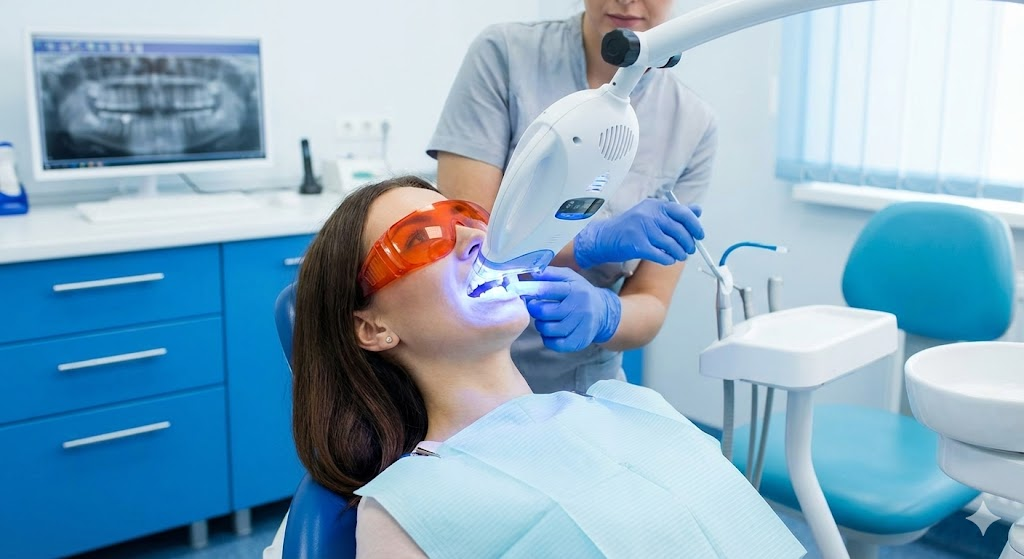
Will Whitening Actually Work on Your Teeth?
This is the question worth answering before you spend anything, and it is the one most whitening advertising carefully avoids. Whitening works by peroxide diffusing through enamel and breaking down the coloured molecules trapped inside it. That is extremely effective against some causes of discolouration and does essentially nothing against others.
It works well on the ordinary browning and yellowing that comes with age, coffee, tea, red wine, curries and smoking. Those stains sit within the enamel and dentine in a form peroxide can break apart, and most patients with that pattern get a genuine, visible several-shade improvement.
It works poorly or not at all on several common situations. Grey-toned teeth, particularly from tetracycline exposure in childhood, respond slowly and often disappointingly. White or brown fluorosis patches may become more obvious rather than less, because the surrounding tooth lightens while the patch does not. A single dark tooth after an old knock is usually a dead nerve, which needs internal whitening or a crown rather than anything applied to the outside. And crowns, veneers and white fillings do not change colour at all — so whitening around them makes them stand out, sometimes badly enough that they need replacing to match.
There is also a category where the problem is not stain at all. Teeth that look increasingly yellow at the edges with thin translucent tips are usually showing enamel erosion — the darker dentine underneath becoming visible as the enamel thins. Whitening does not fix that, and the acid habit causing it needs addressing first. Getting this diagnosis right is the entire value of having whitening supervised rather than bought online.
What Causes the Colour, and What Fixes It
Match your situation to the row before deciding on treatment.
| What you are seeing | Likely cause | What actually helps |
|---|---|---|
| Even yellowing across all teeth, worse with age | Age plus dietary staining | Whitening — this is the case it was designed for |
| Brown staining, heavier near the gum line | Coffee, tea, wine, tobacco | A professional clean first, then whitening |
| Grey rather than yellow overall | Tetracycline exposure or ageing dentine | Whitening helps slowly and modestly; veneers may be the realistic option |
| One tooth noticeably darker | A dead nerve after an old knock | Internal whitening or a crown — external whitening will not reach it |
| White or brown mottled patches | Fluorosis | Whitening can worsen the contrast; resin infiltration or microabrasion is usually better |
| Translucent, darkening biting edges | Enamel erosion from acid | Address the acid source; whitening will not restore lost enamel |
| Teeth fine but a crown or filling looks wrong | Restorations do not whiten | Whiten first, then replace the restoration to match the new shade |
| White marks after braces came off | Decalcification during orthodontics | High-fluoride products, tooth mousse, or resin infiltration — not whitening |
If your row is not one of the top two, whitening on its own is unlikely to give you what you want, and it is better to know that before you pay for it.
The Three Ways to Whiten, Compared Honestly
Including the one we do not sell.
- 1
Supermarket and Online Products
We do not provide theseWhitening toothpastes are abrasives — they remove surface stain and cannot change the underlying colour of the tooth, and the more aggressive ones wear enamel over time. Strips and kits sold online contain low concentrations or, worryingly, sometimes undisclosed high ones. The genuine risks with unsupervised products are chemical burns to the gums from ill-fitting trays and whitening a mouth full of crowns that will not match afterwards. Charcoal products are abrasive and there is no good evidence they whiten.
- Cheapest
- Surface stain only
- Gum burn risk from generic trays
- No diagnosis of what is causing the colour
- 2
Custom Take-Home Trays
Most popularTrays made from a scan of your own teeth, so the gel sits against the teeth and not the gums, plus professional-strength gel and instructions specific to your situation. You wear them for a set period each day over one to two weeks. Slower than in-chair but the results are comparable, sensitivity is easier to manage because you control the pace, and you keep the trays for occasional top-ups later — which is what actually makes results last.
- Results over 1–2 weeks
- Gentler on sensitive teeth
- Trays kept for future top-ups
- Requires you to actually do it
- 3
In-Chair Whitening
FastestA single appointment of roughly an hour to ninety minutes. Your gums are isolated and protected, then a high-concentration gel is applied in several cycles. You see the change the same day, which is why it suits a wedding or an event with a deadline. Sensitivity is more likely than with take-home because of the concentration, though it typically settles within a day or two. Often combined with take-home trays for maintenance.
- Visible change same day
- Gums professionally protected
- Higher chance of temporary sensitivity
- Best for a fixed deadline
How It Runs
Diagnosis first, whitening second.
- 01
Assessment
We identify what is causing the colour, check for decay and gum problems that would make whitening uncomfortable, and note every crown, veneer and front filling that will not change shade.
- 02
Clean first
A professional clean removes surface stain and tartar. Some people are happy at this point and need nothing further, which we will happily tell you.
- 03
Shade record
The starting shade is recorded and usually photographed. Without a baseline, judging the result afterwards is guesswork — teeth look different in different light and memory is unreliable.
- 04
Whiten and review
In-chair, take-home, or both. Then a review to check the result, discuss any sensitivity, and plan whether any restorations now need replacing to match.
Making It Last
Results fade. How fast is largely up to what happens in the first 48 hours and the following year.
The first 48 hours
Enamel is temporarily more porous straight after whitening, which makes it unusually vulnerable to picking up new stain — the opposite of what you want.
- Avoid coffee, tea and red wine
- Avoid curry, beetroot and soy sauce
- No smoking
- Stick to pale foods where you can
Managing sensitivity
Temporary sensitivity is normal and settles within a day or two. It happens because peroxide temporarily opens the microscopic tubules in the enamel.
- Sensitive toothpaste for a week before and after
- Space out applications if using trays
- Avoid very hot and cold drinks briefly
- Tell us — the concentration can be adjusted
Long-term maintenance
Professional results typically last one to three years depending on your habits. Keeping the custom trays means a short top-up costs very little.
- Occasional top-up with your own trays
- A straw for iced coffee and cola
- Rinse with water after staining drinks
- Regular cleans remove surface stain
Frequently Asked Questions
- How white will my teeth actually get?
- It depends far more on your starting point and the cause of the discolouration than on the product. For ordinary age and dietary yellowing, several shades is a realistic expectation and that is a very visible difference. Grey-toned teeth improve much less. What we will not promise is a specific shade, because nobody honestly can — teeth have a natural limit set by the colour of the dentine underneath the enamel, and no amount of peroxide goes past it. At the consultation we record your starting shade and give you a realistic range rather than a marketing number.
- Does whitening damage enamel?
- Professional whitening supervised by a dentist does not damage enamel at the concentrations and exposure times used. The peroxide temporarily opens the microscopic tubules in the tooth, which is why sensitivity happens, and they close again afterwards. The genuine risks are elsewhere: chemical burns to the gums from generic trays that let gel sit on soft tissue, and the abrasive damage from whitening toothpastes and charcoal products used aggressively over years. Those are real, and they are the reason supervision matters more than the concentration does.
- Why do my crowns and fillings look wrong after whitening?
- Because they cannot whiten. Porcelain and composite hold whatever shade they were made in, permanently. If you whiten the natural teeth around a front crown, the crown stays where it was and now looks noticeably darker than everything else. This catches people out constantly and it is why we identify every restoration in your smile at the assessment. The correct sequence is to whiten first, wait about two weeks for the shade to stabilise, and then replace any restoration that no longer matches — which is an additional cost you should know about before you start, not after.
- Can I whiten if I have sensitive teeth?
- Usually yes, with adjustments. We would generally recommend take-home trays rather than in-chair, because you control the pace and can space out applications. Using a sensitive toothpaste for a week before you start and throughout makes a real difference, and the gel concentration or wear time can be reduced. It is also worth investigating why the teeth are sensitive first — exposed root surfaces from gum recession, or erosion, or a cracked tooth all cause sensitivity and all need different management. Whitening on top of an undiagnosed problem is uncomfortable and pointless.
- How long do the results last?
- Typically one to three years, and the variation is almost entirely about habits rather than the treatment. Daily coffee, tea, red wine or smoking will pull the colour back faster. The practical answer is that keeping your custom trays makes maintenance trivial — a short top-up once or twice a year costs very little in gel and keeps the result indefinitely. That, more than the initial treatment, is what separates people who are still happy at three years from people who are not.
- Is in-chair whitening better than take-home?
- It is faster, not necessarily better. In-chair gives you a visible change in one appointment, which matters if you have a wedding in a fortnight. Take-home trays reach a comparable end point over one to two weeks with less sensitivity, and you keep the trays afterwards. A lot of patients do both — an in-chair session to get most of the way there, then trays for the last stage and for maintenance. If you have no deadline and sensitive teeth, take-home is usually the more sensible choice.
- Should my teenager whiten their teeth?
- We would generally ask them to wait. Teenage enamel is still maturing and the pulp chamber inside the tooth is larger and closer to the surface, which means more sensitivity for less result. There is also usually a more specific explanation for the colour that needs a different treatment — decalcification marks left after braces, a single dark tooth from an old knock, or erosion from an energy drink habit. Have it looked at before buying anything, particularly anything advertised on social media, much of which is either ineffective or abrasive enough to do harm.
- Can I whiten while pregnant or breastfeeding?
- The usual advice is to postpone it. There is no good evidence that whitening harms a pregnancy, but there is also no good evidence establishing safety, and whitening is entirely elective — there is no clinical cost to waiting a few months. Pregnancy also brings its own gum changes that make the mouth more sensitive. What is genuinely worth doing during pregnancy is a check-up and clean, because pregnancy gingivitis is common and worth managing.
- Do health funds cover whitening?
- Generally not, because it is considered a purely cosmetic procedure. Some policies with a cosmetic component may contribute — worth ringing your fund with the item number to check rather than assuming either way. The professional clean that we do beforehand is normally claimable in the usual way as part of your general dental cover, so at least part of the visit typically is.