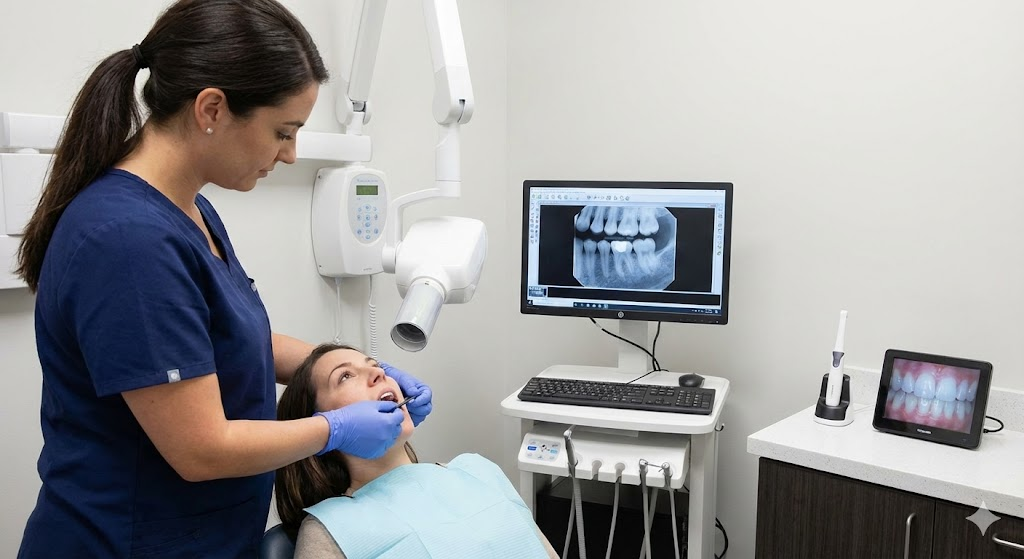
Technology Is Only Worth Mentioning If It Changes Something for You
Practices list their equipment the way restaurants list their suppliers, and most of it means nothing to the person in the chair. So rather than a catalogue, here is what digital dentistry actually changes about your appointment — and where it makes no difference at all.
The single biggest change is impressions. For decades, making a crown, a denture, a night guard or an orthodontic retainer meant a tray of putty pushed against your palate for several minutes while you tried not to gag. For a significant number of people that was the worst part of dentistry, and some avoided treatment because of it. An intraoral scanner replaces it entirely with a small wand that photographs your teeth in a couple of minutes, with nothing pressing on your soft palate. If you have a strong gag reflex, this one change is worth more to you than everything else on this page combined.
The second is that you can see what we see. An intraoral camera puts a magnified image of a specific tooth on a screen in front of you. It is very different to decide about a cracked filling while looking at it than to decide while being told about it, and it also means that when we say something can be monitored rather than treated, you can see why.
The third is that images can be compared year on year. That sounds mundane and it is genuinely the most clinically significant one. Most hard decisions in dentistry are questions about change — is this shadow bigger than it was, has this recession moved, is this crack propagating. Consistent digital records turn a subjective impression into a real comparison, which is what allows a dentist to leave something alone with confidence instead of treating it just in case.
Most hard decisions in dentistry are questions about change. Consistent records turn a judgement call into a comparison.
What Changed, Specifically
The honest version, including where the difference is small.
| Task | How it used to be | What it is now |
|---|---|---|
| Impressions for a crown or guard | A tray of putty held against the palate for minutes | A scanning wand, a couple of minutes, nothing on the soft palate |
| X-rays | Film packets, chemical processing, a wait | Digital sensors, image on screen in seconds, notably lower dose |
| Seeing the problem | The dentist describes it to you | A magnified photograph of your own tooth on the screen |
| Planning an implant | Two-dimensional x-rays and judgement | 3D imaging showing bone volume and exactly where the nerve runs |
| Sending work to the lab | A physical model couriered across town | A digital file sent immediately, with no distortion in transit |
| Tracking a change over years | Comparing films of varying angle and exposure | Consistent digital images compared side by side |
| The filling itself | Drill, material, cure, adjust | Largely unchanged — the skill is still manual |
That last row matters. Digital tools improve diagnosis, planning and comfort. They do not replace the manual craft of restoring a tooth well.
The Equipment, and What Each Piece Is For
Six things, and why they exist.
Intraoral Scanner
No puttyReplaces impression putty for crowns, dentures, night guards and aligners. The single biggest comfort improvement in twenty years, particularly if you gag.
Digital X-rays
Low doseSensors rather than film, producing an image within seconds at a substantially lower dose than the film systems they replaced.
Intraoral Camera
A pen-sized camera that puts a magnified image of a specific tooth on the screen, so you are looking at the problem rather than hearing about it.
3D Cone Beam Imaging
When indicatedThree-dimensional imaging used where a flat x-ray is genuinely not enough — implant planning, difficult wisdom teeth, hidden infection.
Digital Records
Consistent images stored over years, which is what makes it possible to tell whether something has actually changed rather than guessing.
CAD/CAM Design
Restorations designed on screen from the scan, so the fit is worked out digitally before anything is made.
Radiation, In Context
Frequently Asked Questions
I gag on impressions. Is scanning really better?
For most people with a gag reflex, dramatically. The trigger is usually the impression tray pressing against the soft palate at the back of the mouth, plus the sensation of material flowing backwards, held for several minutes. A scanner is a small wand moved over the teeth from the front, taking a couple of minutes with nothing pressing on the palate, and you can stop at any point without ruining the result — which you cannot do with putty that is already setting. If you have avoided a crown or a night guard because of impressions, this genuinely removes that obstacle.
Are digital x-rays safe?
Yes. Digital sensors need substantially less radiation than the film systems they replaced, and the dose from a set of bitewings is a small fraction of the natural background radiation you receive simply from living in Perth over a year — less than a domestic flight. We also use a lead apron and thyroid collar as standard. That said, the right approach is not to take them casually because the dose is low. Every x-ray should be answering a specific question, and we will tell you what that question is.
How often should x-rays be taken?
It depends on your risk, and applying one interval to every patient is not good practice. Someone with active decay or a history of many fillings might need bitewings every twelve to eighteen months. Someone with a stable mouth, no fillings and good hygiene might reasonably go two or three years. If you have recent x-rays from a previous dentist, bring them or have them transferred — we can often use those rather than repeating them, which saves you both money and exposure.
When do I need a 3D scan rather than a normal x-ray?
Only when a flat image genuinely cannot answer the question, because a cone beam scan is a higher dose than a standard x-ray and should not be routine. The clear indications are implant planning, where we need to know bone volume and exactly where the nerve canal runs; assessing a wisdom tooth sitting close to the nerve before removal; investigating a suspected fracture or an infection that is not visible on standard films; and some jaw joint assessments. If someone proposes a 3D scan for a routine check-up, ask what question it is answering.
Does digital dentistry cost more?
Generally not for the patient, and sometimes less. The equipment is a significant investment for a practice, but digital procedures are not separately surcharged — scanning is simply how we take an impression now. Where it can genuinely save you money is by reducing appointment counts, since a scan can often be taken in the same visit as the preparation rather than requiring a separate impression appointment, and by reducing remakes, because a digital file does not distort on the way to the lab the way a physical model can.
Can I see my own x-rays and images?
Yes, on the screen during your appointment, and you can have copies at any time without giving a reason — they are your health records and you have a right of access under Australian privacy law. If you want them to take to another practice for a second opinion, we will email them across. Any practice that makes this difficult when significant treatment is being proposed is telling you something worth listening to.
Can you make a crown in a single visit?
Some practices with in-house milling can, and it is a genuine convenience. The realistic picture is that same-visit crowns suit straightforward cases well, while complex aesthetic work — particularly front teeth where shade and translucency matter — usually still benefits from a skilled lab technician's hands and a second appointment. We will tell you which category your tooth is in and what the visit count will be before you start rather than during.
Does the technology mean fewer appointments?
Often, yes, though the effect is smaller than the marketing suggests. Scanning removes separate impression appointments and digital files reach the lab immediately rather than by courier, which trims real time from a crown or aligner case. What technology cannot compress is biology — an implant still needs three to four months for the bone to fuse, and no scanner changes that. Where it makes the biggest difference to visit counts is in avoiding remakes, because the fit is verified digitally before anything is manufactured.