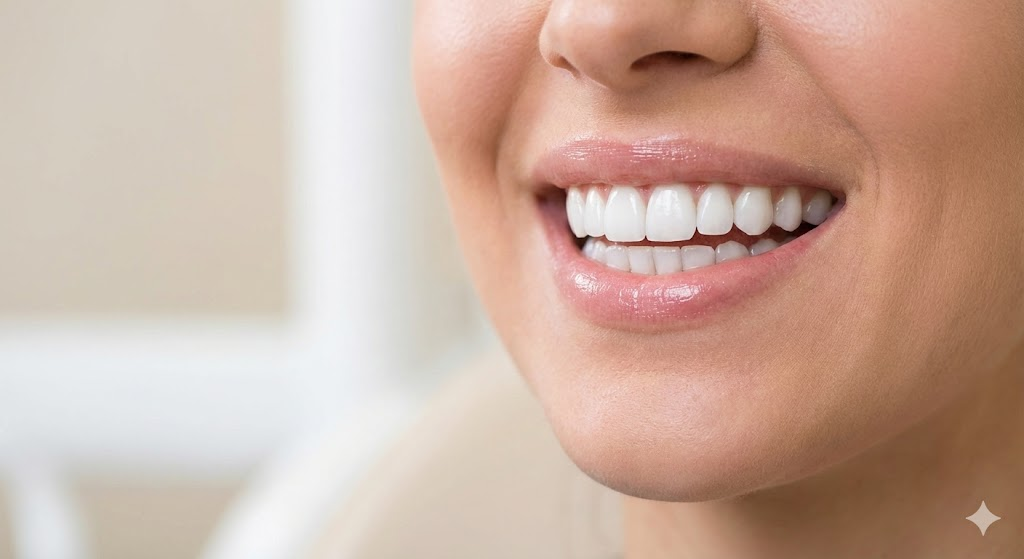
The Most Common Mistake Is Starting at the Top
A patient comes in unhappy with their front teeth and leaves with a quote for eight veneers. It happens constantly, and quite often the veneers were not the right answer — they were simply the first answer.
Veneers are permanent. Making one requires removing a layer of enamel from the front of the tooth, and enamel does not grow back. Once a tooth has been prepared for a veneer it will need a veneer or a crown on it for the rest of your life, and each replacement over the decades removes a little more. That can be an entirely reasonable trade for the right tooth. It is a poor trade for a tooth whose only problem was that it was slightly yellow, or slightly rotated, or had a small chip.
So we work up rather than down. Whitening first, because a surprising proportion of complaints about teeth are complaints about colour, and whitening touches nothing. Then alignment, because slightly crowded front teeth can often be moved rather than covered. Then bonding, which adds composite to a tooth without removing enamel and is fully reversible. Only after those have been considered and ruled out do we talk about porcelain.
The point is not that veneers are bad. They are excellent for teeth that are genuinely misshapen, heavily filled, or discoloured from the inside where whitening cannot reach. The point is that they should be the answer to a question the simpler options could not solve.
The Ladder, Least Invasive First
Most smiles are improved at step one or two. We would rather tell you that than sell you step four.
- 1
Professional Whitening
Removes nothingIf the complaint is colour rather than shape, whitening solves it without touching the tooth. It is reversible, it is the cheapest option, and it establishes your true baseline shade before any permanent work is planned — which matters, because porcelain is matched to a shade and cannot be whitened later.
- No enamel removed
- Reversible
- Works well on age and stain yellowing
- Will not change crowns or fillings
- 2
Clear Aligners
Moves the tooth instead of covering itMild to moderate crowding, spacing and rotation of the front teeth — the typical adult case — can often be corrected by moving the teeth rather than masking them with porcelain. You keep all your enamel. The catch is compliance: aligners need 20 to 22 hours a day, and if that is not realistic for you it is better to know before you start.
- No enamel removed
- Treats the cause, not the appearance
- Typically several months
- Requires genuine compliance
- 3
Composite Bonding
Adds material, removes noneTooth-coloured composite sculpted directly onto the tooth to close a small gap, rebuild a chipped edge, or reshape an uneven tooth. Usually one visit, no anaesthetic for small work, and completely reversible — the composite can be polished off and the tooth is as it was. It stains more than porcelain and needs replacing sooner, which is the honest trade.
- Single visit for most cases
- Fully reversible
- Repairable if it chips
- Typically 5–7 years
- 4
Porcelain Veneers and Crowns
PermanentFor teeth that are genuinely misshapen, heavily restored, worn, or discoloured from the inside where whitening cannot reach. Porcelain resists staining, holds its polish, and lasts longer than composite. It also requires enamel removal that cannot be undone, so it should be a considered decision made with a mock-up in front of you rather than a same-day yes.
- Typically 10–15 years
- Excellent stain resistance
- Enamel removal is permanent
- Two or more visits
Choosing Between Them
Same problem, different answers depending on the tooth in front of us.
| If the problem is | Usually the answer is | Because |
|---|---|---|
| General yellowing with age | Whitening | The tooth shape is fine; only the colour has changed, and colour is reversible |
| A single dark tooth after an old knock | Internal whitening or a crown | The nerve has died — external whitening will not reach the discolouration |
| A small chip on a front edge | Composite bonding | One visit, no enamel removed, and it can be reshaped later as the tooth ages |
| Slightly crowded or rotated front teeth | Clear aligners | Moving the tooth keeps your enamel; covering it spends enamel to hide the problem |
| A small gap between the front teeth | Bonding or aligners | Both are conservative; which one depends on the size of the gap and your bite |
| A heavily filled, discoloured front tooth | Veneer or crown | There is not enough sound enamel left for a conservative option to hold |
| Teeth worn short from grinding | Diagnose the grinding first | Rebuilding without a night guard means the new work wears down faster than the enamel did |
| A gummy smile | Gum contouring, possibly with orthodontics | The teeth may be the right size and simply covered by excess gum tissue |
These are typical answers, not rules. What is right for your teeth depends on your bite, your enamel and what you want, which is what the consultation is for.
How a Cosmetic Case Runs
Nothing irreversible happens until you have seen what you are agreeing to.
- 01
Consultation
What specifically bothers you — which is often quite different from what a dentist would notice first. Photographs, a scan, and an assessment of your bite and gum health.
- 02
Health before beauty
Any decay, failing fillings or gum disease is dealt with first. Cosmetic work built on unstable foundations is the most common way expensive dentistry gets wasted.
- 03
Mock-up and plan
A digital or physical preview of the proposed result, plus a written plan with item numbers and costs. This is the point to change your mind, and plenty of people do.
- 04
Treatment and review
The work itself, staged over the number of visits agreed in advance, then a review to check the bite, the shade and how it feels once you have lived with it.
Frequently Asked Questions
What is the difference between a veneer and a crown?
A veneer covers the front surface of a tooth and a thin edge over the biting edge, so it needs a reasonable amount of sound tooth behind it to bond to. A crown covers the whole tooth, which means more preparation but far more strength. The rough rule is that a veneer is for a structurally sound tooth with an appearance problem, and a crown is for a tooth that has been weakened — heavily filled, root-treated, or cracked. If a dentist offers you a veneer on a tooth with a large existing filling, ask what is left for it to bond to.
How much do veneers cost?
Nobody can responsibly quote that before examining you, and a firm per-tooth figure given over the phone will be revised later. The number depends on how many teeth, whether alignment is needed first, whether existing fillings have to be replaced, and whether your bite would destroy porcelain within a year. What you should expect is a written plan with item numbers after a consultation, which you can take to your health fund and to another dentist. That is the only quote worth having. Note also that health funds generally treat purely cosmetic work as non-claimable, though a crown that also restores function is usually a different matter.
Do veneers ruin your teeth?
They commit them. Preparing a tooth for a porcelain veneer removes a layer of enamel that does not regenerate, so that tooth will need a veneer or crown on it permanently, and each replacement across the decades takes a little more. That is a fair trade for a tooth that genuinely needed the treatment and a poor one for a tooth that was only slightly yellow. There are also minimal-prep veneers for some cases, which remove very little. The honest answer is that they are not damaging, but they are irreversible, and that is a real thing to weigh.
How long do veneers and bonding last?
Porcelain veneers typically run ten to fifteen years and sometimes considerably longer; composite bonding usually five to seven. What generally ends a veneer is not the porcelain failing but the tooth underneath — decay at the margin, or gum recession exposing the join. Grinding shortens both dramatically, which is why we assess for it before starting. Neither is a lifetime purchase, and you should budget for replacement at some point. Anyone promising a permanent result is overselling.
Is cosmetic dentistry painful?
Mostly no. Whitening and small bonding are usually done without anaesthetic and the main after-effect is temporary sensitivity that settles in a day or two. Veneer and crown preparation is done under local anaesthetic, so the appointment itself is comfortable, and the soreness afterwards is generally mild and manageable with over-the-counter pain relief. If you are anxious about the injection, say so — topical gel and delivering the anaesthetic slowly makes a large difference and takes an extra ninety seconds.
Can I have a smile makeover in one visit?
Some of it. Bonding and whitening can be done in a single appointment. Anything involving porcelain cannot, because the restorations have to be made — that is at least two visits, and a comprehensive case involving alignment first runs over months. Be sceptical of anyone offering a full porcelain makeover in a day; it means no mock-up, no time to review the shape and shade, and no opportunity to change your mind before the enamel is gone.
Will my health fund cover any of this?
Generally not for purely cosmetic treatment. Where a procedure also restores function or repairs damage — a crown on a cracked tooth, a filling that happens to be tooth-coloured — it is usually claimable in the normal way. The practical step is to get the item numbers from your written plan and ring your fund, because they will tell you exactly what they rebate on your policy. Major dental has its own annual limit, separate from and much lower than general dental, and it resets on 31 December for most funds.
I grind my teeth. Does that rule cosmetic work out?
No, but it changes the plan and it must be dealt with first. Grinding is what wore or chipped the teeth in the first place for a lot of patients, and porcelain placed into an unmanaged grinding habit will chip or debond, usually within a couple of years. The answer is a properly made hard night guard, made from a scan of your teeth, worn from the outset. Anyone willing to place veneers on a grinder without addressing it is setting up a repeat visit at your expense.
Can you match a single front tooth to the others?
It is the hardest thing in cosmetic dentistry, and worth being realistic about. A single central incisor sits right next to its identical twin, so the eye compares them directly — shade, translucency at the edge, surface texture and how light passes through. A good result is achievable and takes photography, careful shade-matching and sometimes a lab technician seeing you in person. Where it is genuinely impossible to match perfectly, the alternative is treating both front teeth so they match each other, and we will tell you honestly which situation you are in.