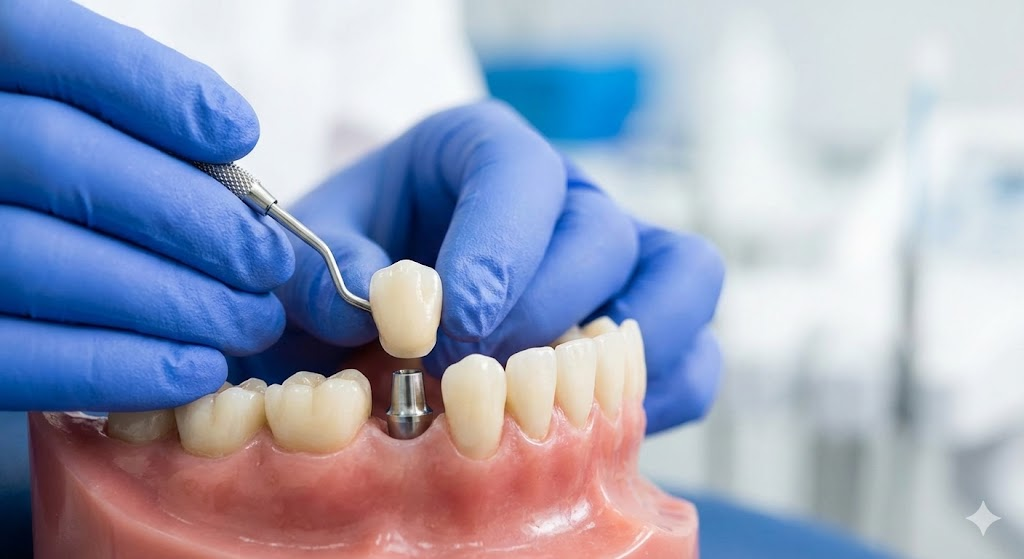
What an Implant Actually Is, and What It Is Not
A dental implant is a titanium post placed into the jaw bone to act as an artificial tooth root. Over three to four months the bone grows onto its surface and locks it in place — a process called osseointegration — after which a crown, bridge or denture can be attached to it. It is the only tooth replacement that puts something back into the bone rather than resting on top of it.
That matters for a reason most people are never told. When a tooth is lost, the bone that used to hold it begins to shrink, because bone maintains itself in response to load and there is no longer any load. Over years this changes the shape of the jaw, which is why long-term denture wearers find their dentures loosening and why their facial profile changes. An implant loads the bone again and largely stops that process locally.
What an implant is not is a quick fix or a maintenance-free tooth. It takes months, most of which is waiting rather than treatment. It can develop peri-implantitis, which is essentially gum disease around an implant, and it fails more often in smokers, in poorly controlled diabetics, and in people whose cleaning slips. And it is not always the right choice — for some gaps a bridge is better, for some a partial denture is entirely adequate, and for the occasional back tooth the correct answer is to leave the gap alone.
It is the only tooth replacement that puts something back into the bone rather than resting on top of it.
The Real Timeline for a Single Implant
Four to six months end to end for a straightforward case, longer if grafting is needed. Only a handful of those are actual appointments — most of the time is healing you spend getting on with your life.
- Visit 1
Assessment and 3D planning
Examination, a scan, and 3D imaging to see exactly where the bone is and where the nerve runs. This is also where we establish whether an implant is the right answer at all, and whether your gum health will support one long term.
- If required
Extraction or bone graft
If the tooth is still present it may need removing first, and if the bone has already shrunk a graft may be needed to build a foundation. Grafting adds several months of healing before placement can happen.
- Visit 2 · about 1 hour
Placing the implant
Done under local anaesthetic. Most patients report it as less unpleasant than having the tooth out. Soreness afterwards is usually mild and manageable with over-the-counter pain relief for a couple of days.
- 3–4 months
Osseointegration
The bone fuses to the implant surface. This cannot be rushed and it is the part people are most surprised by. If the gap is visible when you smile, you wear a temporary throughout — you are not without a tooth.
- Visit 3
Abutment and scan
The connector that joins implant to crown is fitted and we scan for the final crown. A short appointment.
- Visit 4
Fitting the crown
The permanent crown is fitted and the bite adjusted carefully — an implant has no ligament and cannot feel light contact the way a natural tooth does, so getting the bite right is done by us, not by feel.
Types of Implant Treatment
From a single gap to a full arch.
Single Tooth Implant
1 implantReplaces one tooth without touching the teeth either side — the main advantage over a bridge, which requires cutting down two healthy neighbours.
Multiple Tooth Implants
2+ implantsSeveral missing teeth replaced with individual implants, or with a bridge supported by two implants spanning a longer gap.
Implant-Retained Denture
2–4 implantsA denture that clips onto two or more implants instead of resting on the gum. Transformative for lower dentures, which are the ones that never stay put.
Full Arch Restoration
4–6 implantsA fixed bridge supported by four to six implants replacing an entire upper or lower arch. A major undertaking requiring careful planning and staging.
Are You a Candidate?
Most adults with a missing tooth are. These are the factors that make it straightforward, and the ones that need a proper conversation first.
Generally straightforward
- Healthy gums with no active periodontal disease
- Adequate bone volume, confirmed on 3D imaging
- A non-smoker, or willing to stop around the procedure
- General health stable and medications known to us
- Good day-to-day cleaning habits
- Willing to attend maintenance visits long term
Needs discussion first
- Active gum disease — this must be stabilised before placement
- Smoking, which measurably increases failure rates
- Poorly controlled diabetes, which slows healing
- Significant bone loss, which may require grafting
- Bisphosphonates or similar bone medications — tell us before anything else
- Heavy grinding, which needs managing to protect the restoration
Implant, Bridge, Denture or Nothing
An implant is often the best option and it is not the only one. This is the comparison we would want if it were our tooth.
| Option | What it involves | The honest trade-off |
|---|---|---|
| Implant | Surgery, then months of healing, then a crown | Best long-term outcome and preserves bone, but slowest and most expensive |
| Bridge | Two visits; the teeth either side are cut down to carry it | Fast and effective, but it spends two healthy teeth and the bone underneath still shrinks |
| Partial denture | Impressions and fitting over a few visits | Much cheaper and removable, but less stable, and it rests on gum rather than loading bone |
| Leave the gap | Nothing, plus monitoring | Reasonable for some rear molars; risky elsewhere, as neighbouring teeth drift and the opposing tooth over-erupts |
Which is right depends on where the gap is, how much bone is there, your general health and your budget. We would rather set out all four than present one.
Frequently Asked Questions
- Does getting an implant hurt?
- The placement itself is done under local anaesthetic, so you should feel pressure but not pain. Most patients say it was less unpleasant than having the tooth extracted, which surprises people who expect the opposite. Afterwards there is usually mild soreness and some swelling for two or three days, managed with over-the-counter pain relief. If you are very anxious, say so at the planning stage — how the anaesthetic is delivered makes a real difference, and for severe anxiety we can discuss referral for sedation.
- How long do implants last?
- Well-placed implants in a well-maintained mouth have very good long-term survival, with published studies reporting high success rates past ten and fifteen years, and many implants last decades. Two caveats worth having plainly. The crown on top is a separate component with its own lifespan and may need replacing during the life of the implant. And survival depends heavily on you — peri-implantitis, which is gum disease around an implant, is a genuine cause of late failure, and it is much more common in smokers and in people who stop attending maintenance visits. An implant is not a maintenance-free tooth.
- Why does it take four to six months?
- Because bone grows slowly and there is no way around that. After the implant is placed, the bone has to grow onto and lock into its surface, which takes three to four months in most people. Loading it before that fusion is complete risks the implant failing entirely. Add a bone graft and you are adding several more months before placement can even begin. It is worth knowing this at the outset, because the wait is the part people find hardest and it is entirely predictable.
- Will I have a gap while I wait?
- Not one anybody will see. If the missing tooth is visible when you smile, we provide a temporary — usually a removable partial or a temporary bridge — for the healing period. In some carefully selected cases a temporary crown can be attached immediately at placement, though this depends on how stable the implant is when it goes in and is not appropriate for everyone. What we will not do is promise immediate teeth before we have seen your bone.
- Can I eat normally with an implant?
- Once healed, yes, with essentially no restrictions — that is the main reason people choose implants over dentures. During the first few weeks after placement we recommend keeping to softer food and chewing on the other side. The one genuine caution afterwards is that an implant has no periodontal ligament, so it does not feel pressure the way a natural tooth does. You cannot tell you are biting too hard on it, which is why the bite is adjusted carefully at fitting and rechecked at reviews.
- I have been wearing a lower denture for years and it will not stay put. Can implants help?
- This is one of the most reliably transformative things in dentistry. Lower full dentures are notoriously unstable because there is no palate to hold suction and the tongue dislodges them constantly. Two implants placed in the front of the lower jaw, with the denture clipping onto them, changes that completely — the denture stays in, you can eat properly, and it costs far less than a full arch of fixed teeth. If you have spent years with denture adhesive, this is worth asking about.
- What if I do not have enough bone?
- Bone grafting is routine and it is what allows implants to be placed in sites that have been empty for years. The amount and type depends on how much has been lost — a small amount placed at the same time as the implant, or a more substantial graft that has to heal for several months before placement. In the upper back jaw a sinus lift is sometimes needed to create height. All of it adds time and cost, which is why the 3D scan at the planning stage matters so much: it tells us what we are dealing with before you have committed to anything.
- Are implants covered by health funds?
- Partially, usually, and less than people hope. Implants fall under major dental, which has a separate annual limit that is typically much lower than the general dental limit and resets on 31 December for most funds. Because implant treatment naturally spans several months, it can often be staged across a year boundary to access two years of limit — worth planning deliberately rather than discovering afterwards. Get the item numbers from your written plan and ring your fund; they will tell you exactly what they rebate. Payment plans are available for the balance.
- Does smoking really matter that much?
- Yes, and it is one of the few things we will be blunt about. Smoking reduces blood supply to the healing site, impairs osseointegration, and significantly increases both early implant failure and late peri-implantitis. It is the single largest modifiable risk factor. We will still treat smokers, but you deserve to know the odds are worse before you spend the money, and stopping for the weeks around placement and healing measurably improves the outcome.